

Scleral lens wearers know that proper lens care is essential to protect both your lenses and your eyes. This guide walks you through everything you need to know to care for your sclerals, from daily cleaning to filling solutions to general safety guidelines.
We know there’s a lot to remember, especially at first, so feel free to bookmark this page or keep it handy for reference. Over time, your care routine will become second nature.
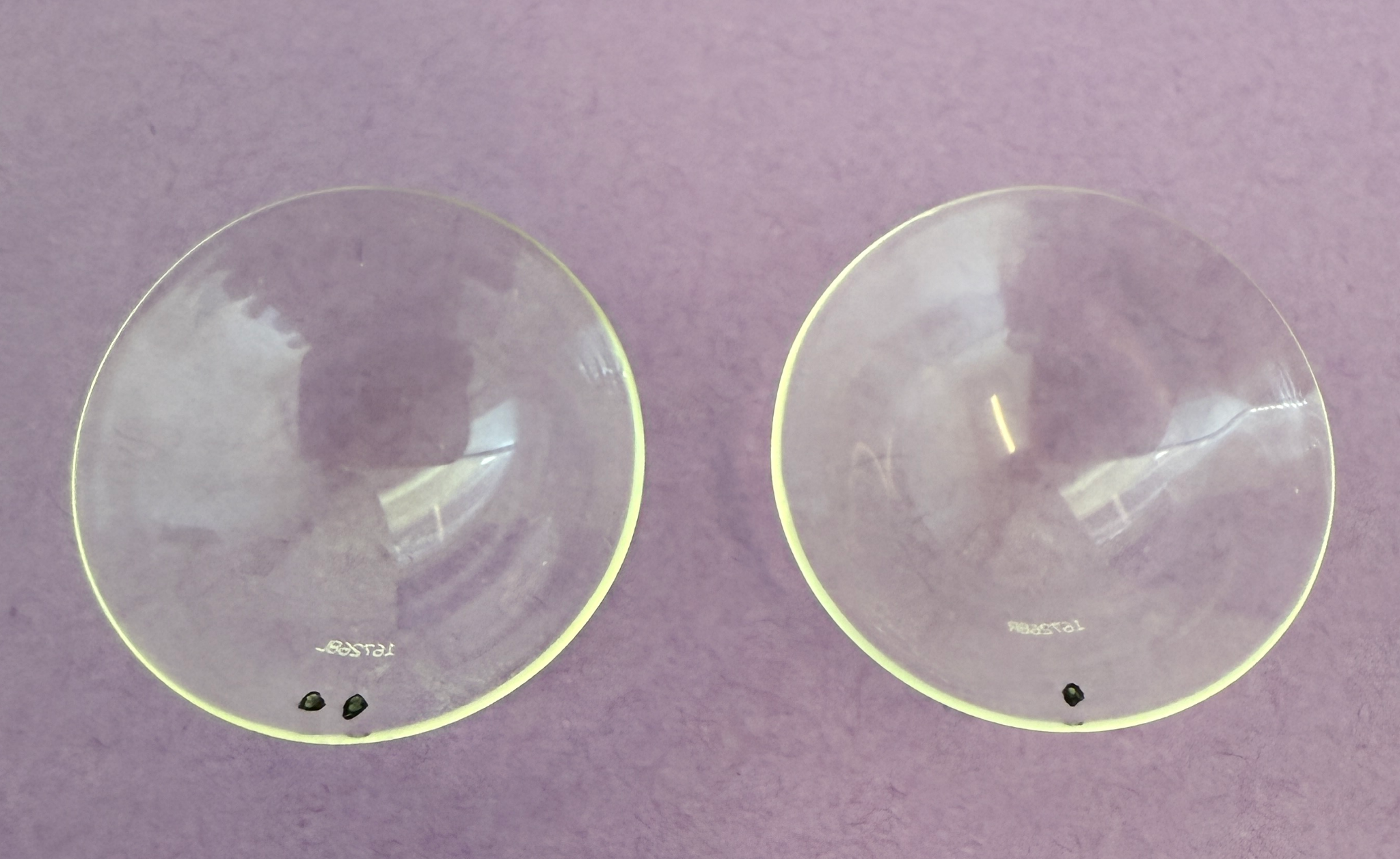
Right vs. Left: How to Tell Them Apart
Your lenses may look identical, but they are custom-fit for each eye. Here’s how to tell them apart:
| Eye | Marking |
| Right Lens | One dot |
| Left Lens | Two dots |
Dot Positioning when Inserting Lenses: Always check the markings before inserting your lenses. Before long, checking for those dots will become just another automatic part of your lens routine.
With most conventional scleral lenses, theoretically you can insert the lens any way you want and it should rotate to the correct position, which is usually with the dot at the bottom, or at the six o’clock position when inserting them (as shown above). Boston Sight sclerals are inserted with the dots at the twelve o’clock position when inserting.
With scan or impression-based scleral lenses, such as EyeFit or EyePrint, the dot will be at the bottom when inserting. These types of lenses are fit to your eye like a “fingerprint” so it is important for them to be inserted with the dots at the bottom of the lens so the fit is aligned with your eye.
Faded Dots: Sometimes, the pH of our tears makes the dots fade over months or years. If this happens, you can call us to see when we are in the office to stop by for a complimentary re-dotting of your lenses, or you can do it yourself at home with a permanent marker. Note that if you use UniquepH as a cleaning solution, the dots on your contact lenses will fade faster due to the composition of the solution.
Overnight Cleaning: Protecting Your Lens Coating
Cleaning your scleral lenses is critical for removing protein, lipid deposits, debris, and bacteria that accumulate during wear.
Recommended Lens Storage/Cleaning Solution: TANGIBLE CLEAN
Tangible Clean is specifically formulated to clean your lenses while being gentle on lenses that are coated with Hydra-PEG coating. This solution is our favorite because it has a watery consistency and is easy to rinse off in the morning with your sterile saline. The other overnight lens cleaners tend to be “goopier” and harder to rinse off.
You can visit the TANGIBLE website, which offers access to “Care Coaches” if you have any questions about the solution.
Compatible Backup Solutions
If you need a backup, these solutions are available at drugstores and are also compatible with HydraPEG coated lenses:
| Solution | Notes |
| Boston Simplus (Bausch + Lomb) | Multipurpose solution. |
| ClearCare (Alcon) | Requires 6+ hours soak in the specific case provided. |
| Unique pH (Menicon) | Multipurpose solution. Will remove dots on lenses faster. |
Important Lens Storage and Cleaning Reminders
- Always store lenses in Tangible Clean or another compatible solution
- DO NOT rinse your lenses in tap water—this destroys the lens coating and puts you at risk of an eye infection called acanthamoeba
- Change your contact lens case every 1–3 months, or each time you get a new bottle of cleaning solution.
Step-by-Step Cleaning Process
If you drop your lens or simply need to store it overnight or briefly (like during a short nap or shower), here’s what to do:
- Place the lens in your palm
- Add a few drops of Tangible Clean (or other multipurpose solution)
- Gently rub each side of the lens with your fingertip. Store in the solution while you take a nap or shower.
- When the lens is removed from the solution and you are ready to insert the lens, rinse the lens well with your preservative-free sterile saline filling solution before re-inserting – more details on these salines follow in the next step.
- Filling Your Lenses Prior to Insertion: The Most Critical Step
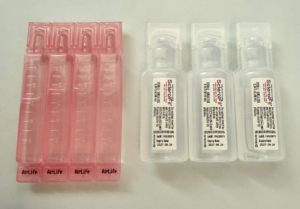
All sclerals lenses must be filled with saline before insertion, each time they are worn. This is one of the most important rules in scleral lens care: only use PRESERVATIVE-FREE STERILE SALINE like Modudose, Lacripure, or Scleralfill (pictured below), to fill the bowl of your scleral lens before insertion.
Why Preservative-Free Filling Saline Matters
Multipurpose solutions contain preservatives and chemical disinfectants, which is why we DO NOT use them to fill scleral lenses. When trapped behind a scleral lens against your cornea for hours, these preservatives can cause:
- Corneal toxicity
- Stinging and burning
- Inflammation
- Corneal staining
Never use multipurpose solution to fill your lenses!
Most multipurpose contact lens solutions contain preservatives like polyquaternium-1 (PQ-1) or biguanides (PHMB). These preservatives are designed to disinfect and prevent bacterial growth in the bottle—not to sit against your cornea for hours. While these preservatives are “likely safe when used with CLs” for their intended purpose, they “may cause ocular adverse events,” including corneal staining and epithelial keratopathy if the solution sits on your corner for too long (like inside a scleral lens)
Your Best Scleral Lens Filling Solution Options
| Option | Product | Notes |
| #1 | Modudose (“Pink Tubes”) – 0.9% sodium chloride inhalation solution saline (preservative-free) | Available via Amazon, HonestMed.com. Most affordable option, unbuffered. |
| #2 | LacriPure, TangibleFill – preservative-free saline | Available online, unbuffered. |
| #3 | ScleralFil – buffered preservative-free saline | Available online. Closer to the pH of our natural tears. |
| #4 | Any preservative-free artificial tear | Good backup if you forget your solution on vacation (but more expensive long-term). |
All the solutions you need are available on our website under “For Patients” → “Order Supplies.”
Rewetting Drops and Artificial Tears
During the day, you may experience some dryness or fogging. Preservative-free artificial tears are safe to use with scleral lenses.
Recommended PF (Preservative Free) Brands
- BioTrue Hydration Boost
- iVIZIA
- Systane
- Blink
- TheraTears
- Refresh Relieva PF
Usage Tip for PF Rewetting Drops
You can use preservative-free rewetting drops as needed with your lenses, either prior to insertion or while the lenses are in, or both.
Reading and Computer Glasses over Scleral Lenses
Scleral lenses are typically prescribed for distance vision. If you’re in your 40s or beyond, you may need reading or computer glasses for close work if your lenses do not have a multifocal component. Read more about Multifocal Sclerals here.
Here are some recommendations for COMPUTER GLASSES to be used with your scleral lenses:
| Age | Recommended Add Power Range |
| 40 to 50 years old | +1.00 D to +1.50 |
| 50 and beyond | +1.50 D to +1.75 |
Here are some recommendations for READING GLASSES to be used with your scleral lenses:
| Age | Recommended Add Power Range |
| 40 to 50 years old | +1.00 to +2.00 |
| 50 and beyond | +2.00 to +2.50 |
Discuss your visual needs with your practitioner and try on a few different measurements to determine the ideal power for your activities.
Essential Safety Rules for Scleral Lenses: DO’s and DON’Ts
✅ ALWAYS
- Wash your hands before handling your lenses or touching your eyes
- Use preservative-free saline to rinse and fill your lenses
- Store lenses in Tangible Clean or another compatible overnight solution
- Change your lens case every 1–3 months
- Reach out to our office via text, phone call, or email if you experience any issues.
❌ NEVER
- Sleep in your contact lenses – Greatly increases your chance of an eye infection.
- Swim, shower, or enter hot tubs/steam rooms with your lenses on – Increases risk for water-borne infections, which can be severe.
- Rinse your lenses in tap water – Destroys the lens coating and can introduce harmful microorganisms.
- Store lenses dry if they have HydraPEG coating on them – Damages the coating.
- Use multipurpose solution to fill your lenses – Causes toxicity and discomfort
When to Contact Our Office
Remove your lenses and connect with our office ASAP if you experience any of the following:
- Blurred vision
- Eye irritation or pain
- Extra Red eyes
- Any other concerns
Do not wait to connect with us over any issues or questions —early intervention can prevent more serious complications.
Quick Reference Card
| Task | Solution | Notes |
| Identify lenses | One dot = Right, Two dots = Left | Dots may fade over time but can be re-applied as needed. |
| Overnight storage | Tangible Clean | Keeps the coating on your lenses conditioned for as long as possible. |
| Dropped lens cleaning | Tangible Clean (or Boston Simplus, Unique pH) | Rub gently, rinse with filling solution |
| Filling scleral bowl before insertion | Preservative-free sterile saline (Modudose, LacriPure, ScleralFil) | NEVER use multipurpose solution! |
| Rewetting during the day | Preservative-free artificial tears | Use under or over lenses as needed. |
| Lens Case replacement | Change every 1–3 months | A new case should come with new bottles of lens cleaner |
| Tap water | NEVER use | Destroys coating, causes infections |
| Sleeping
Swimming |
NEVER do with contact lenses | Increases acanthamoeba infection risk |
Ordering Supplies
All the solutions you need are available in our office, or on our website under “For Patients” → “Order Supplies.” Stock up regularly so you never run out.
The Bottom Line
Your scleral lenses are a significant investment in your vision and quality of life. Proper care protects both your lenses and your eye health. With the right routine, your lenses will serve you well for years to come!
