


(5 minute read, skip to end for TLDR summary 😁)
A topic that comes up often in our exam rooms, especially for our patients who love their scleral lenses but are starting to notice the natural effects of aging on their near vision, is adding multifocal capability.
If you’re in your 40s or beyond and wear scleral lenses—perhaps for conditions like keratoconus, severe dry eye, or irregular corneas—you’ve likely experienced the frustrating “push-up” effect. Your distance vision through your scleral lenses is fantastic, but reading a menu, looking at your phone, or seeing your dashboard clearly has become a struggle. You might be holding things farther and farther away just to focus.
The good news is, you have options! Let’s compare the most common options so you know exactly what to expect from both a vision and adaptation standpoint.
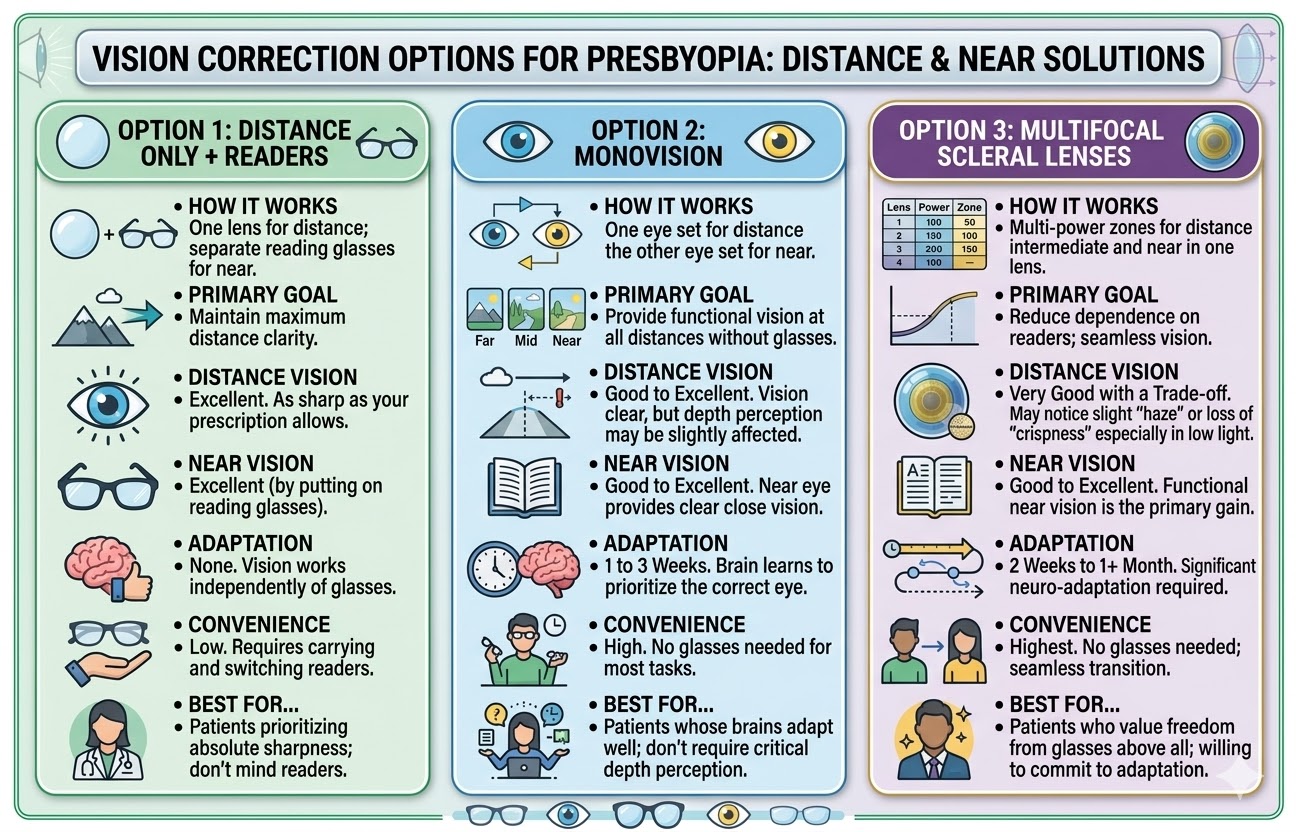
Option 1: The “Distance Only + Readers” Approach
This is often the simplest starting point. We fit your scleral lenses perfectly for crisp distance vision. Then, when you need to read or do close work, you simply put on a pair of over-the-counter reading glasses.
- Clarity: Your distance vision will be as sharp as possible. Your near vision, through the readers, will also be very clear.
- Convenience: It requires carrying readers with you and putting them on and taking them off throughout the day. It’s a bit like switching from a camera’s wide-angle lens to a macro lens.
- Adjustment Time: There is virtually **no adjustment period** for your vision itself, as the lenses and glasses work independently. The only adjustment is remembering to have your readers handy!
- Who it’s great for: People who only need near vision for short periods or specific tasks and don’t mind the hassle of glasses.
Option 2: Monovision
In this approach, we fit one eye for clear distance vision and the other eye specifically for clear near vision. Your brain learns to automatically prioritize which eye to use based on what you’re looking at.
- Clarity: This can work beautifully for many, providing functional vision at all distances without glasses.
- The Trade-off: Some people find it can subtly affect depth perception, especially for activities like driving at night.
- Adjustment Time: ***Expect a neuro-adaptation period of 1 to 3 weeks.*** During this time, your brain is learning this new way of seeing and prioritizing signals from each eye. We often start with a trial period in familiar, low-stakes environments to let this adjustment happen comfortably.
- Who it’s great for: Patients whose brains are adept at visual processing and who don’t require critical depth perception for their daily work or hobbies.
Option 3: Multifocal Scleral Lenses
This is where the art and science of our specialty contact lens training really shines. A multifocal scleral lens is designed with sophisticated optics to provide a continuum of focus—from distance, to intermediate (like your computer screen), to near—all in *each* lens. Think of it like having a progressive lens built directly into your custom scleral lens.
However, because this option represents the biggest change from how your single-vision distance lenses work, it requires the most realistic expectations. Before we go into what the MultiFocal journey looks like, here is the breakdown of expectations for adding MultiFocal to your lenses:
- Clarity: Functional vision across all distances—distance, intermediate (computer), and near—in a single lens. While you will gain the ability to see your phone, a book, or your dashboard clearly without readers, you will likely notice a change in your distance vision. Many patients describe it as a very slight “haze” or a loss of “crispness” compared to their old distance-only lenses, particularly in low light or when looking at high-contrast objects like street signs at night.
- The Trade-off: This is the most important thing to understand. Because the lens layers near and distance powers together, the absolute sharpness of your distance vision may diminish slightly. This is not a flaw in the lens; it is the fundamental trade-off for gaining functional near vision. You are exchanging a small degree of “tack-sharp” distance clarity for the convenience of glasses-free vision at all distances.
- Adjustment Time: This option requires the most significant adaptation. You should plan for an adjustment period that can last anywhere from **two weeks to a full month, and sometimes longer.** During this time, your brain is learning an entirely new way to process visual information. Your vision may fluctuate day-to-day, and patience is mandatory. We strongly recommend a two-week trial where you wear the lenses consistently in familiar environments to allow this neuro-adaptation to occur.
- Who it’s great for: Patients who value the freedom from reading glasses above all else and are willing to commit to an adaptation period. This option is best for those who understand that they are trading a slight reduction in distance “crispness” for the reward of functional near vision, and who are prepared to give their brain the time it needs to adapt.
Here’s more on what the Multifocal journey looks like.
The Goal: To reduce your dependence on reading glasses and provide functional vision across all distances in a single lens.
The Reality of the Adaptation Period (What we really want you to know):
Adding multifocal optics to a scleral lens is a significant change for your visual system. It is not an instant switch. You should plan for an **adaptation period that can last anywhere from two weeks to a full month, and sometimes longer.** During this time, your brain is learning an entirely new way to process visual information.
What you will likely experience during adaptation:
The “Vision Dance:” The lens works by creating different zones of power. This means light from far away and up close enters your eye at the same time. Your brain must learn to select the correct signal, and this takes practice.
The Trade-off (This is critical): Because we are layering near and distance powers together, you will almost certainly notice a change in your distance vision compared to your old lenses. Many patients describe it as a very slight “haze,” a loss of “crispness,” or a faint ghosting around fine details, especially in low light or when looking at high-contrast objects like street signs at night. **This is not a flaw in the lens; it is the fundamental trade-off for gaining functional near vision.** The absolute sharpness of your distance vision may diminish slightly, but your ability to see your phone, a book, or your computer screen clearly will dramatically improve.
Patience is mandatory: Your vision may fluctuate day-to-day during this period. Some days will feel clearer than others. It is essential to push through this and give your brain consistent input. We strongly recommend a two-week trial where you wear the lenses in familiar, comfortable environments to allow this neuro-adaptation to occur.
What is the best option for me?
At In Focus, we believe every patient is unique. Your eyes are not a one-size-fits-all prescription, and your visual needs are deeply personal. That’s why we offer a full spectrum of solutions.
For patients with complex corneas or severe dryness, we might recommend an impression-based scleral lens, like EyePrintPro. These are crafted from a precise mold of your eye to provide a fit that is truly unparalleled. When you combine that level of customized fit with a multifocal design, the potential for both comfort and functional vision is extraordinary.
We also utilize Higher Order Aberration (HOA) scleral lenses for patients who struggle with glare, halos, or a general lack of sharpness. Adding multifocal capability to an HOA lens can be a game-changer for someone who wants both high-definition vision *and* the convenience of near focus.
The Bottom Line: Be Honest With Yourself About Your Priorities
Moving from a distance-only scleral lens to a multifocal design is a journey toward visual freedom, but it is a journey with a very specific trade-off. You are exchanging a small degree of that “tack-sharp” distance clarity for the convenience of functional near vision.
If absolute crispness at distance is your number one priority, especially for things like night driving, the distance-only plus readers option may be your best fit.
If you are willing to accept a subtle change in distance perception for the reward of glasses-free near vision, and you are committed to giving your brain the time it needs to adapt, multifocal scleral lenses can be truly life-changing.
We are here to guide you through every step of your vision journey. If you’re curious about whether multifocal scleral lenses are right for you, we’d love to sit down with you, listen to your visual goals, and have an honest conversation about what you can truly expect.
Have questions about your options? Give our team a call or schedule a consultation. We’re here to help you see your world, In Focus.
