

If you live with dry, gritty, or burning eyes, you know that a simple eye drop isn’t enough. This is especially true if you live in a dry climate, battle seasonal allergens, face daily air pollution, or manage an autoimmune condition like Sjögren’s syndrome. These factors can create a perfect storm of ocular inflammation, pain, and damage to the front of the eye.
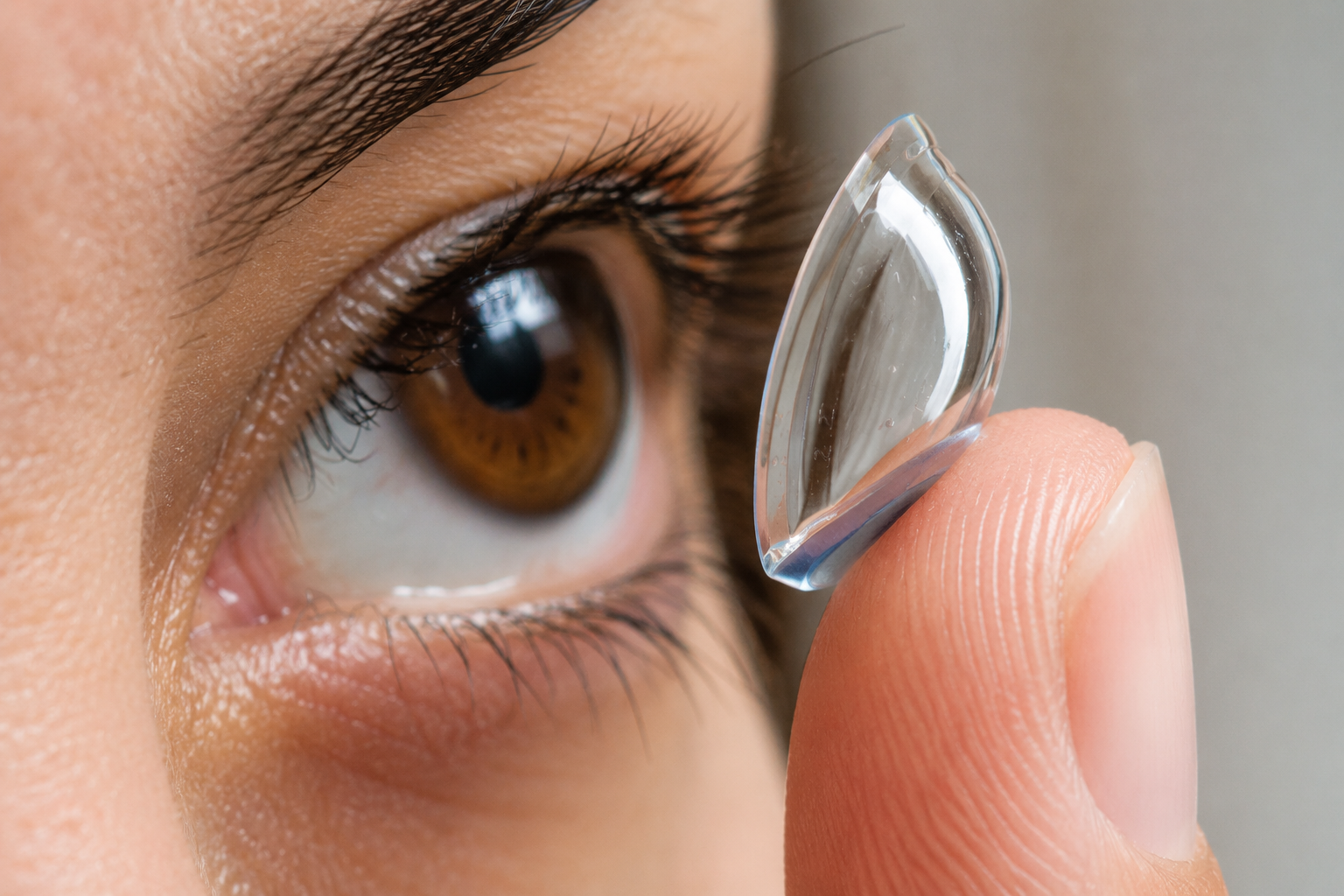
But what if your contact lens could act as a protective shield while also enhancing your vision? This is where larger-diameter scleral lenses, particularly impression-based designs like EyePrintPro, offer an impactful solution.
The Problems: Environment, Auto-Immune, Post-Surgical Conditions
Environmental and post-surgical factors accelerate tear evaporation and trigger inflammation:
- Dry climate pulls moisture from your eyes within minutes
- Allergens (pollen, mold) land directly on the cornea
- Air pollution (smoke, smog, dust) introduces irritants that stick to the ocular surface
- Corneal irregularities from surgery or post surgical conditions
Autoimmune conditions can often take this problem to another level entirely. For patients with Sjögren’s syndrome, lupus, rheumatoid arthritis, or graft-versus-host disease (GVHD), the body attacks its own moisture-producing glands. The result is severe aqueous deficient dry eye—meaning your eyes produce little to no tears naturally.
“These patients often cycle through every artificial tear, gel, and prescription drop on the market—only to find temporary relief at best. The cornea becomes chronically exposed, inflamed, and vulnerable to damage. This is where the added coverage of larger-diameter EyePrint lenses can really make a difference,” says Dr. Morrison.
The Solution: A Fluid Reservoir Shield
Scleral lenses vault over the sensitive cornea and rest entirely on the “white” of the eye (the sclera). This creates a tear-filled reservoir over the cornea. Larger-diameter sclerals offer three key advantages for environmental and autoimmune sufferers:
- Complete Isolation: The larger the lens, the more completely it seals off the cornea and sclera from the outside environment. Dry air, pollen, pollution, and airborne irritants never touch your corneal surface.
- Constant Hydration: The reservoir bathes the cornea in your own nutrient-rich tears (or preservative-free saline) 100% of the time you wear the lens. For Sjögren’s patients with little to no natural tears, this artificial fluid chamber provides what their own bodies cannot.
- Corneal Healing Environment: By keeping the cornea submerged in fluid 8–12 hours a day, the surface can actually heal. Many autoimmune patients report reduced corneal staining, fewer erosions, and less pain after switching to large-diameter sclerals.
Why “Larger” Matters
Standard sclerals are large, but impression-based lenses (like EyePrintPro) take it a step further. These lenses use a precise physical mold (impression) of your eye’s unique shape (see a video of the process here). This allows the lens to land perfectly on the least sensitive scleral tissue, maximizing comfort and centration even at a larger diameter.
The farther back you go in the eye, the more irregular the eye becomes. This is why the impression takes a more accurate picture of the eye, allowing for better alignment as you go larger. This results in reduced fogging, increased comfort, and better vision due to the improved centration of the lenses.
For patients with irregular scleral surfaces due to inflammation or scarring, this custom landing zone is essential. A one-size-fits-all scleral might pinch or not cover enough surface for real relief. An impression-based lens matches your exact contours as a replica of your own unique cornea, providing the maximum benefit available.
Reasons a Patient Might Need Larger-Diameter Lenses
Patients often require larger lenses for reasons beyond dry eye and autoimmune disease:
- To Avoid Corneal Touch: In conditions like keratoconus or after corneal surgery (e.g., transplants), the cornea is irregularly steep. A larger lens vaults higher, ensuring the back of the lens never touches the sensitive, scarred cornea.
- To Land on Healthy Tissue: After multiple eye surgeries or injuries, the conjunctiva (the clear tissue covering the sclera) can be scarred or bumpy. A larger diameter allows the doctor to find a “clean,” healthy landing zone away from damaged areas.
- Need for Prism to Correct Double Vision: Patients with double vision (diplopia) often require prism in their contact lenses. Prism adds a small amount of weight to the lens. Larger-diameter impression-based scleral lenses are exceptionally stable and distribute that extra weight evenly, preventing rotation or shifting. This makes them the preferred lens type for patients needing prism.
- To Improve Lens Centration: On very large or oddly shaped eyes, a smaller scleral lens might shift. Larger lenses “grab” more scleral surface area, locking the lens in place for stable, clear vision.
- To Manage Severe Ocular Surface Disease: For conditions like Stevens-Johnson syndrome, GVHD, or advanced Sjögren’s, the entire ocular surface is compromised. Only a large, fluid-filled vault can protect and heal the eye.
- To Accommodate Lagophthalmos, incomplete eyelid closure: In some autoimmune or post-surgical cases, the eyelids don’t close properly or have irregular tension. With GVH, some patients experience globe protrusion that inhibits eye closure; some patients experience lax lids as they age prohibiting lid closure; patients may have Bell’s palsy that hasn’t completely resolved – for all of the aforementioned experiences, larger lens can provide more eye protection, as well as a smoother, more stable interface with the lids.
Real-World Impact for Patients
Consider a typical patient suffering from severe dry eye or auto-immune condition: constant burning, foreign body sensation, light sensitivity, and blurry vision that fluctuates throughout the day. They may be using preservative-free drops every 30 minutes. Many cannot tolerate standard contact lenses at all.
With a well-fitted, large-diameter, impression-based, scleral lens design like EyePrintPro, these same patients often report:
- All-day comfort without midday drop use,
- Clear, stable vision that doesn’t blur as the day goes on,
- Reduced pain and photophobia,
- Fewer corneal abrasions and infections.
What You Should Know: Pricing, Data, and Time
It’s important to understand that larger-diameter impression-based scleral lenses are a significant investment compared to conventional sclerals—but the technology and customization are substantially different.
| Conventional Scleral Lens | Larger-Diameter Impression-Based Lens | |
|---|---|---|
| Fitting data points | None (uses trial lenses and topography) | ~40,000 to 80,000+ data points from the physical mold |
| Average cost | Base price | Approximately double the cost |
| Fitting time | 8-12 weeks typical | Adds approximately 1 month to the process (molding, lab fabrication, verification) |
Why the difference? A conventional scleral lens is fit using diagnostic trial lenses and corneal topography—essentially “educated guessing” within a range of standard curves. An impression-based lens starts with a physical mold of your exact eye. That mold captures tens of thousands of data points (up to 80,000) about the unique shape, bumps, and asymmetries of your sclera. The lab then crafts a lens that matches your eye, not an average.
The extra month accounts for:
- scheduling the impression visit,
- shipping the mold to the lab,
- custom fabrication, which takes longer than standard lens production – about 4 weeks, noting that expediting lenses at an additional cost can speed up production to about a week.
For patients who have failed conventional lenses or have complex scleral shapes, the extra time and cost are often well worth it.
The Bottom Line
When the environment attacks or your own immune system turns against your eyes, it helps to know many patients find relief with a shield. Larger, custom scleral lenses don’t just correct vision—they can restore ocular health, comfort, and quality of life.
While the cost of larger diameter sclerals is higher than that of conventional or regular impression-based lenses, and the fitting process is usually one month, longer, the possibilities the 80,000+ data points of your unique eye shape can be very impactful.
For patients with complex corneas, severe dry eye, or autoimmune conditions, the investment is often life-changing.
If you have Sjögren’s syndrome, lupus, rheumatoid arthritis, or any condition causing severe dry eye, ask your specialty contact lens practitioner about larger-diameter impression-based scleral lenses like EyePrintPro. The relief the larger fluid reservoir provides, along with the customized fit could be life-changing!
Patient Review
Read a recent review from patients who have tried larger format lenses below:
“I just got back from a bike ride – something that I have not been able to in three years since my eye issues started. Last night, I drove at night confidently with 20/15 vision. I now recognize the person looking back at me in the mirror because I no longer have to wear heavy glasses due to my high prescription. I feel like myself again.
Dr. Morrison and the entire team at In Focus made all of that possible. Dr. Morrison has given me my life back. I’ve spent the years since my severe dry eye diagnosis in pain and deeply grieving the life I used to have. I now have a brand new start filled with hope and optimism thanks to Dr. Morrison and my Eye Print Pro lenses.
I flew from upstate NY to Arizona for my appointments, and it was one of the best decisions I have ever made. Dr. Morrison’s expertise, compassion, and positivity made the entire fitting process a pleasure. Her scleral lens expertise and algorithms led to a perfect fit.
My lenses are comfortable, nearly eliminated my dry eye symptoms, and provide me with 20/15 vision. Margaree trained me on lens insertion/removal. Her patience, tips, positivity, and encouragement gave me the confidence to tackle lens insertion/removal head on. I was able to go to the office 2x per day everyday during my Arizona trip to practice. I learned so much during those practice sessions, and they were vital to my at-home lens success.
Dr. Morrison and the entire In Focus team deeply care about their patients and set them up to succeed. They were worth every plane ride!”
– In Focus Patient Review (via Google Reviews), EyePrintPRO lenses
